| Version 10 (modified by , 10 years ago) ( diff ) |
|---|
SAM/BAM quality control: Analyzing short read quality (after mapping)
Remove Duplicates
- Remove duplicates, for eg. from PCR
  #samtools command
   samtools rmdup [-sS] <input.srt.bam> <output.bam>
   -s or -S depending on PE data or not
Determining the paired-end insert size for DNA samples
If paired-end insert size or distance is unknown or need to be verified, it can be extracted from a BAM/SAM file after running Bowtie.
When mapping with bowtie (or another mapper), the insert size can often be included as an input parameter (example for bowtie: -X 500), which can help with mapping. See the mapping SOP for mapping details.
Method 1: Get insert sizes from BAM file
   # Using a SAM file (at Unix command prompt)
   awk -F "\t" '$9 > 0 {print $9}' s_1_bowtie.sam > s_1_insert_sizes.txt
   # Using a BAM file (at Unix command prompt)
   samtools view s_1_bowtie.bam | awk -F"\t" '$9 > 0 {print $9}' > s_1_insert_sizes.txt

   # and then process column of numbers with R (or Excel)
   # In R Session
   sizeFile = "s_1_insert_sizes.txt"
   sample.name = "My paired reads"
   distance = read.delim(sizeFile, h=F)[,1]
   pdf(paste(sample.name, "insert.size.histogram.pdf", sep="."), w=11, h=8.5)
   hist(distance, breaks=200, col="wheat", main=paste("Insert sizes for", sample.name), xlab="length (nt)")
   dev.off()
Method 2: Calculate insert sizes with CollectInsertSizeMetrics function from picard (http://picard.sourceforge.net). This is also a good approximation for RNA samples.
   #
   # I=File    Input SAM or BAM file.  (Required)
   # O=File    File to write the output to.  (Required)
   # H=File    File to write insert size histogram chart to.  (Required)
   # output: CollectInsertSizeMetrics.txt: values for -r and --mate-std-dev can be found in this text file
   #         CollectInsertSizeMetrics_hist.pdf: insert size histogram (graphic representation)
bsub java -jar  /usr/local/share/picard-tools/CollectInsertSizeMetrics.jar I=foo.bam O=CollectInsertSizeMetrics.txt H=CollectInsertSizeMetrics_hist.pdf
QC to get a (visual) summary of mapping statistics. For eg. coverage/distribution of mapped reads across the genome or transcriptome
| Picard: CollectRnaSeqMetrics.jar to find coverage across gene body for 5' or 3' bias
[RNA-seq only] Get global coverage profile across transcripts
Do reads come from across the length of a typical transcript, or is there 3' or 5' bias (where most reads come from one end of a typical transcript)?
One way to look at this is with Picard's CollectRnaSeqMetrics tool
   # Usage:
   java -jar /usr/local/share/picard-tools/CollectRnaSeqMetrics.jar INPUT=bamFile REF_FLAT=refFlatFile STRAND_SPECIFICITY=NONE OUTPUT=outputFile REFERENCE_SEQUENCE=/path/to/genome.fa CHART_OUTPUT=output.pdf VALIDATION_STRINGENCY=SILENT
   # Example command
   java -jar /usr/local/share/picard-tools/CollectRnaSeqMetrics.jar INPUT=WT.bam REF_FLAT=/nfs/genomes/mouse_mm10_dec_11_no_random/anno/refFlat.txt STRAND_SPECIFICITY=NONE OUTPUT=QC_metrics/WT.RnaSeqMetrics.txt REFERENCE_SEQUENCE=/nfs/genomes/mouse_mm10_dec_11_no_random/fasta_whole_genome/mm10.fa CHART_OUTPUT=QC_metrics/WT.RnaSeqMetrics.pdf VALIDATION_STRINGENCY=SILENT
The VALIDATION_STRINGENCY=SILENT option will keep the program from crashing if it finds something unexpected. The default: VALIDATION_STRINGENCY=STRICT
| QualiMap: can be used on DNA or RNA-Seq to get summary of mapping and coverage/distribution
# Graphical interface: enter 'qualimap' on the command line
# Command line:
unset DISPLAY  #needed for submitting to cluster
bsub "qualimap bamqc -bam myFile.bam -outdir output_qualimap"
# For huge data, you can increase memory with --java-mem-size="4800M" to avoid OutOfMemoryError: Java heap space


#rnaseq qc
bsub "qualimap rnaseq -bam myFile.bam -gtf Homo_sapiens.GRCh37.72.canonical.gtf -outdir output_qualimap_rnaseq -p non-strand-specific"

#counts qc (after using htseq-count or similar program to generate a matrix of counts)
qualimap counts -d countsqc_input.txt -c -s HUMAN -outdir counts_qc
#Format of countsqc_input.txt (below), totalCounts.txt is a matrix of counts; header lines must be commented "#" and species is human or mouse only.
#Sample	Condition	Path	Column
HMLE1	HMLE	totalCounts.txt	2
HMLE2	HMLE	totalCounts.txt	3
HMLE3	HMLE	totalCounts.txt	4
N81	N8	totalCounts.txt	5
N82	N8	totalCounts.txt	6
N83	N8	totalCounts.txt	7
| RSeQC: RNA-Seq quality control package for getting mapping statistics (eg. unique/multi-mapped reads)
bam_stat.py -i myFile.bam
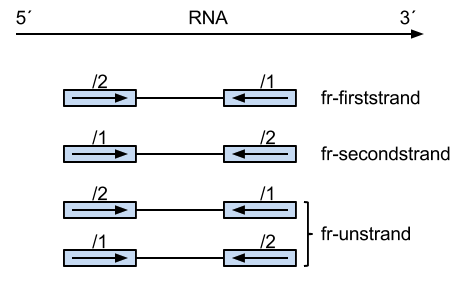
infer_experiment.py from RseQC package: Check if/how your RNA-seq reads are stranded.
# Command line:

bsub "infer_experiment.py -i My_sample.accepted_hits.bam -r human_genes.bed > My_sample.infer_experiment.out.txt"

-i INPUT_FILE in SAM or BAM format
-r Reference gene models in bed format (converted from GTF file).

--library-type=fr-unstranded
--library-type=fr-firststrand
--library-type=fr-secondstrand

# sample output on strand-specific PE reads (since the first fraction is much larger than the second fraction):
This is PairEnd Data
Fraction of reads explained by "1++,1--,2+-,2-+": 0.9807
Fraction of reads explained by "1+-,1-+,2++,2--": 0.0193
Fraction of reads explained by other combinations: 0.0000
# For gene counting with htseq-count, use --stranded=yes; mapping with TopHat should have been performed with --library-type=fr-secondstrand.

# sample output on strand-specific PE reads (since the second fraction is much larger than the first fraction):
This is PairEnd Data
Fraction of reads explained by "1++,1--,2+-,2-+": 0.0193
Fraction of reads explained by "1+-,1-+,2++,2--": 0.9807
Fraction of reads explained by other combinations: 0.0000
# For gene counting with htseq-count, use --stranded=reverse; mapping with TopHat should have been performed with --library-type=fr-firststrand.

# sample output on non-stranded PE reads (since both fractions are about the same):
This is PairEnd Data
Fraction of reads explained by "1++,1--,2+-,2-+": 0.5103
Fraction of reads explained by "1+-,1-+,2++,2--": 0.4897
Fraction of reads explained by other combinations: 0.0000
# For gene counting with htseq-count, use --stranded=no; mapping with TopHat should have been performed with --library-type=fr-unstranded.

For pair-end RNA-seq, there are two different ways to strand reads:
  i) 1++,1--,2+-,2-+
     read1 mapped to '+' strand indicates parental gene on '+' strand
     read1 mapped to '-' strand indicates parental gene on '-' strand
     read2 mapped to '+' strand indicates parental gene on '-' strand
     read2 mapped to '-' strand indicates parental gene on '+' strand
  ii) 1+-,1-+,2++,2--
     read1 mapped to '+' strand indicates parental gene on '-' strand
     read1 mapped to '-' strand indicates parental gene on '+' strand
     read2 mapped to '+' strand indicates parental gene on '+' strand
     read2 mapped to '-' strand indicates parental gene on '-' strand

For single-end RNA-seq, there are two different ways to strand reads:
  i) ++,--
     read mapped to '+' strand indicates parental gene on '+' strand
     read mapped to '-' strand indicates parental gene on '-' strand
  ii) +-,-+
     read mapped to '+' strand indicates parental gene on '-' strand
     read mapped to '-' strand indicates parental gene on '+' strand
tophat/bowtie library options from http://onetipperday.sterding.com/2012/07/how-to-tell-which-library-type-to-use.html

Graphically analyze read duplication
The R/Bioconductor package | dupRadar can do this, analyzing a BAM file that has had duplicates flagged (such as with Picard's MarkDuplicates tool).
A set of commands can be run with an R script by the package authors available from their | Using the dupRadar package page.
A BaRC script (/nfs/BaRC_Public/BaRC_code/R/dupRadar/dupRadar.R) does both the duplicate marking and the analysis with a command like
# Usage: ./dupRadar.sh <file.bam> <genes.gtf> <stranded=[no|yes|reverse]> paired=[yes|no] outdir=./ threads=1
bsub /nfs/BaRC_Public/BaRC_code/R/dupRadar/dupRadar.R WT.bam /nfs/genomes/mouse_mm10_dec_11_no_random/gtf/Mus_musculus.GRCm38.81.canonical.gtf stranded=no paired=yes outdir=dupRadar_out threads=1
Interpreting quality control issues
See QC Fail Sequencing from the Babraham Institute
Attachments (1)
- tophat_library.png (11.8 KB ) - added by 10 years ago.
Download all attachments as: .zip